
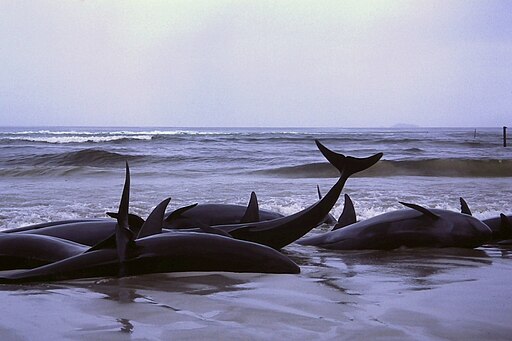
Photo credit: 1986 beached whales in Flinders Bay” by Bahnfrend is licensed under CC BY-SA 3.0.
Cetaceans—whales, dolphins, and porpoises—play a crucial role in marine ecosystems. Their health and population trends serve as indicators of oceanic well-being, helping scientists understand environmental changes and emerging threats. One of the most valuable sources of information about cetacean populations comes from stranding events, where marine mammals become beached or trapped in coastal areas.
The Importance of Cetacean Stranding Monitoring
Monitoring cetacean strandings provides essential data on species diversity, distribution, and potential environmental stressors. However, stranding networks and monitoring programs are often limited due to challenges such as lack of funding, minimal human capacity, and geographic remoteness. Many coastal regions, particularly those with low population density or geopolitical unrest, lack the resources for consistent monitoring. This creates a significant gap in conservation efforts, as crucial data on cetacean strandings remain uncollected in many parts of the world.
A New Solution: Very High-Resolution Satellite Imagery
Recent advancements in very high-resolution (VHR) satellite imagery offer a promising alternative to traditional monitoring methods. These satellites can capture imagery with sub-meter resolution (<1 m per pixel), allowing researchers to detect and analyse cetacean strandings in remote and inaccessible areas. Previously, VHR satellite imagery has been successfully used to identify large whale strandings, such as sei whales in Chilean fjords. However, most mass strandings involve odontocetes (toothed whales), which are generally smaller than baleen whales. To fully harness the potential of VHR satellites for stranding monitoring, their ability to detect and count odontocetes must be assessed.
The First Study of Its Kind
In a pioneering study lead by PhD candidate Penny Clarke, researchers analysed mass strandings of sperm whales (Physeter macrocephalus) and pilot whales (Globicephala spp.) to:
- Determine whether stranded odontocetes can be detected and accurately counted using VHR optical and Synthetic Aperture Radar (SAR) satellite imagery.
- Establish the minimum spatial resolution required for detecting and counting stranded odontocetes.
- Develop standardized, open-source protocols for processing and analysing VHR satellite imagery for cetacean stranding events.
The study examined multiple stranding events in New Zealand and Tasmania, utilising both optical and SAR imagery. The results of this study are currently being prepared for publication.
Enhancing Monitoring with Synthetic Aperture Radar (SAR)
One of the primary challenges of using optical satellite imagery is cloud cover, which can obscure detections. SAR, which operates using radar waves rather than visible light, offers a potential solution by penetrating cloud cover and allowing continuous monitoring, even in poor weather conditions or during night time. SAR has already been used to detect large aggregations of marine mammals, such as walruses, and could prove invaluable for tracking cetacean strandings in challenging environments.
Implications for Global Cetacean Conservation
By identifying the minimum resolution required for accurate odontocete detection and developing open-source protocols, this research will pave the way for more equitable and widespread use of satellite technology in marine conservation. With these tools, even regions with limited resources can implement satellite-based stranding monitoring, helping conservationists gather crucial data and respond to stranding events more effectively.
The long-term goal is to integrate satellite imagery into existing global stranding networks, strengthening conservation efforts and improving our understanding of cetacean populations worldwide. As satellite technology continues to evolve, it holds the potential to revolutionize the way we monitor and protect marine life, ensuring that even the most remote and vulnerable cetacean populations receive the attention they deserve.
 Marie Attard
.JPG)