
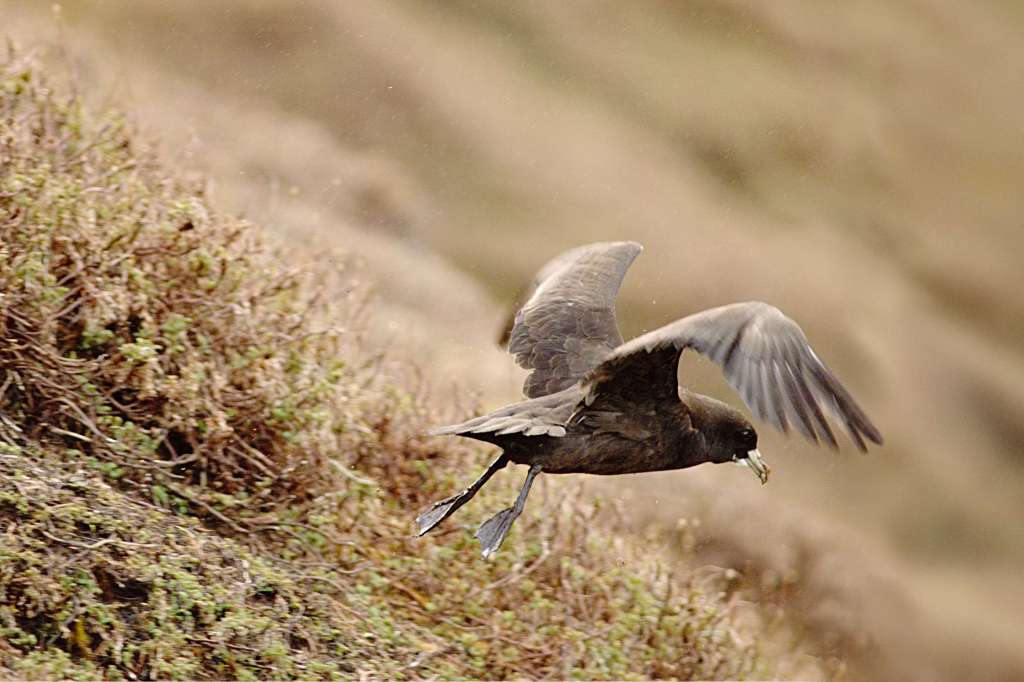
Credit: White-chinned petrel taking off. Photo by François Guerraz. Creative commons licence.
South Georgia hosts globally important populations of seabirds, but many of these populations are declining due to human impacts. Four species of albatrosses and white-chinned petrels are particularly affected by bycatch from fishing activities, while South Georgia shags are experiencing declines linked to climate change and reductions in their primary fish prey. Additionally, burrowing petrels—once abundant—were severely impacted by invasive species like rodents and reindeer, which degraded their habitats and preyed upon their nests.
Monitoring South Georgia’s Seabirds following Invasive Mammal Eradiation Campaign
A major £10 million eradication campaign in the mid-2010s successfully removed these invasive mammals, laying the groundwork for seabird recovery. Now, comprehensive monitoring is essential to assess the current status of South Georgia’s seabird populations and document the anticipated recovery of burrowing petrels.
Remote Monitoring Techniques for Seabird Populations
Traditionally, seabird populations on South Georgia have been monitored through ground and boat-based surveys. However, these methods are costly and often constrained by challenging access to the island’s remote and rugged terrain. In response, our project aims to explore the use of satellite imagery as an innovative, less invasive alternative.
This research aims to:
- Test the feasibility of using satellite imagery to monitor key seabird species, including mollymawks, burrowing petrels, and shags.
- Establish baseline data to track the recovery of burrowing petrels following the eradication of invasive rodents and reindeer.
- Develop remote sensing techniques that could replace costly and logistically complex ground surveys across numerous remote islands worldwide.
Through spectral classification, we will map vegetation richness—a marker for the distribution of burrow-nesting petrels—while textural analysis will help identify mollymawks on land. The project will also examine whether South Georgia shags can be differentiated from penguins in satellite imagery based on unique traits like guano colour and colony density. If successful, these methods will allow the first comprehensive remote census of South Georgia’s seabird populations over the three-year project term.
Why Satellite Imagery?
Satellite monitoring offers a non-invasive, low-carbon alternative to traditional field, boat, and aerial surveys, aligning with global conservation goals. This approach minimises disturbance to wildlife and supports environmental sustainability by reducing the carbon footprint associated with in-person surveys.
Our project will enable extensive, cost-effective monitoring of South Georgia’s seabird populations and trial remote sensing techniques for species with little or no existing population trend data. This is particularly significant for burrowing petrels, which are expected to expand their range following the eradication of invasive rodents and reindeer. Given that burrowing petrels were previously extirpated from many areas, documenting their recovery and distribution is crucial for evaluating the success of past conservation efforts.
The project will also collect valuable data on the status and trends of South Georgia’s albatross populations, including the wandering, black-browed, and grey-headed albatrosses, which are recognised as High-Priority by the Agreement on the Conservation of Albatrosses and Petrels (ACAP).
By developing accurate remote monitoring methodologies, we aim to provide evidence supporting the benefits of rodent eradication and improved fisheries management for reducing seabird bycatch. Our findings will complement on-going projects using UAVs and partnerships with NGOs and the Government of South Georgia and the South Sandwich Islands (GSGSSI), ultimately contributing to a comprehensive report on the health of South Georgia’s seabird populations.
 Marie Attard
