
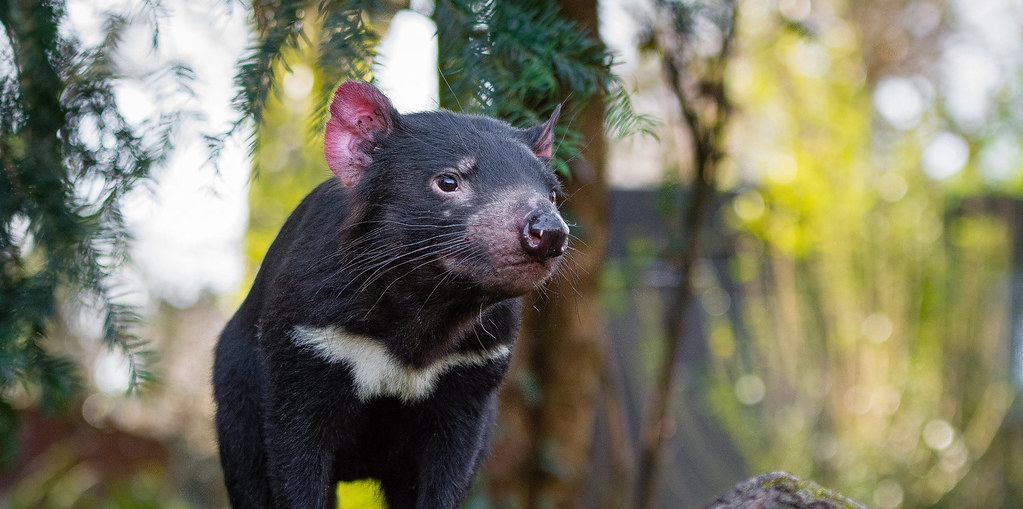
Efforts to conserve the endangered Tasmanian devil are often hindered by a limited understanding of their behaviour in the wild. To address this, innovative approaches are needed to gather data on their diet and movement patterns. One promising technique involves analysing the stable isotope signatures in animal tissues, which can provide valuable insights into an individual’s behaviour over various time scales.
Research using Whiskers as a Tool for Tracking Ecological History in Tasmanian Devils
Whiskers, in particular, offer a unique advantage. Like tree rings, whiskers grow incrementally, with each segment of the whisker laying down stable isotope information as the tissue develops. This means that whiskers can serve as a biological time machine, offering a timeline of an animal’s diet and movement over time. However, to fully interpret this data, we first need to understand the lifespan and growth rate of Tasmanian devil whiskers.
In our study, we marked the whiskers of six captive Tasmanian devils every three months to determine the growth rate of the whiskers. By modelling this growth rate, we can unlock temporal data from whiskers collected from both living animals and museum specimens. This will enable us to track past and present trends in their feeding ecology and movement, helping us make informed decisions for conservation efforts.

Key Findings on Whisker Growth and Ecological Tracking in Tasmanian Devils
In our study of captive Tasmanian devils, we found that whiskers can serve as a detailed record of an animal’s ecological history. By marking the whiskers with 13C- and 15N-labelled glycine and conducting isotopic analysis, we demonstrated that whiskers can track ecological changes for up to nine months. We discovered that whisker growth is not linear; it gradually slows down as the whisker lengthens. This non-linear growth allows for the tracking of monthly and seasonal isotopic shifts, which can reveal changes in habitat use and prey preferences.
Our findings suggest that the longest mystacial whiskers, located in the third and fourth rows, should be prioritised for stable isotope studies, as they provide reliable temporal data. Additionally, the root of the whisker offers a timeframe of 3–63 days, which can be used to accurately adjust the base of cut whiskers for analysis. This research has significant implications for studying the ecological dynamics of both wild and translocated populations of Tasmanian devils.

Exploring Other Tissues for Ecological Insights
In addition to whiskers, there are various other tissues we can analyse to investigate the diet and behaviour of Tasmanian devils. Tissues collected from deceased animals, including muscle, skin, bone, and hair, can provide a diverse range of information about their dietary habits.
Tissues with a short turnover rate, like whole blood, offer insight into an animal’s most recent diet, while longer-living tissues like bone accumulate dietary information over a much longer period, giving an overall average of the animal’s feeding patterns throughout its life. By examining these different tissues, we can piece together a comprehensive picture of the Tasmanian devil’s ecological habits, both in the past and present.
This research offers new opportunities to understand the feeding behaviour and movement patterns of this elusive species, ultimately aiding in more effective conservation strategies.
 Marie Attard