

Image by Josiane Boute from Pixabay
Raptors, or birds of prey such as hawks, vultures, and buzzards, are known for their powerful talons, which are essential for capturing and killing prey. However, despite their significant role in hunting, the variation in talon shape and its impact on a raptor’s ability to capture prey has remained a subject of interest.
In our study, we examined whether the shape of raptor talons evolved primarily due to the bird’s diet or if they were mainly influenced by phylogeny (the evolutionary history of the species) or adult body mass. We focused on the hallux talon — the large, opposable claw found in raptors — from 21 species, representing a wide range of body sizes and feeding strategies, from active predation on medium to large prey to scavenging.
How We Measured Talon Shape
To better understand the variations in talon shape and its effect on biomechanical performance, we combined several analytical techniques, including three-dimensional (3D) geometric morphometrics, finite element modeling, and phylogenetic comparative methods. These tools allowed us to create a detailed picture of how talons function and how their shape varies across species.
Findings: Prey Size Shapes Talon Evolution
Our results showed that raptors that specialise in capturing medium to large prey have longer and more curved talons. These species were clustered in the negative PC1 values (principal component analysis), indicating a distinct talon shape compared to other species. On the other hand, scavengers such as vultures and some species of crows and cockatoos, with shorter and less curved talons, clustered at the positive end of the PC1 scale.
Importantly, we found that the evolution of talon shape is strongly influenced by the size of the prey raptors hunt, rather than just the bird’s overall body mass. Raptors with specialised feeding behaviours, such as those that capture larger prey, have evolved more effective talons suited to grasping and holding onto their prey.
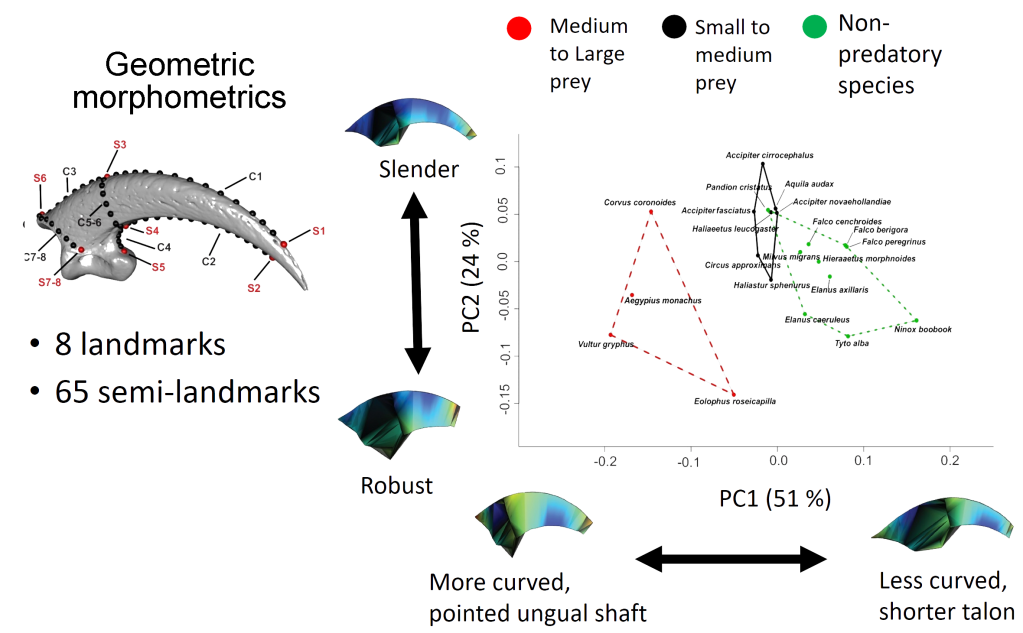
PC1/PC2 scatterplot of the PCA on talon shape variables. Warped meshes refer to positive and negative extremes of the axes. Warped meshes colors refer to the intensity of the shape changes: cooler colours (blue) indicate less change, warmer colours (orange-red) indicate major changes. Image credit: Tsang et al. 2019 Scientific Reports. doi: 10.1038/s41598-019-43654-0
Talon Shape as a Predictor of Feeding Ecology
The study further showed that the biomechanical performance of a raptor’s talons — the way they distribute stress when capturing prey — is highly correlated with the size of the prey, again demonstrating the importance of prey size in shaping talon morphology. Interestingly, body size alone (allometry) was not a strong predictor of talon shape, reinforcing the idea that diet and feeding strategy play a dominant role in determining the form and function of these powerful tools.
This study highlights the adaptive nature of raptor talons and provides new insights into how their shape has evolved to suit the specific dietary needs of different raptor species. By understanding these relationships, we gain a deeper understanding of how these iconic birds have adapted to their ecological niches.

 Marie Attard