

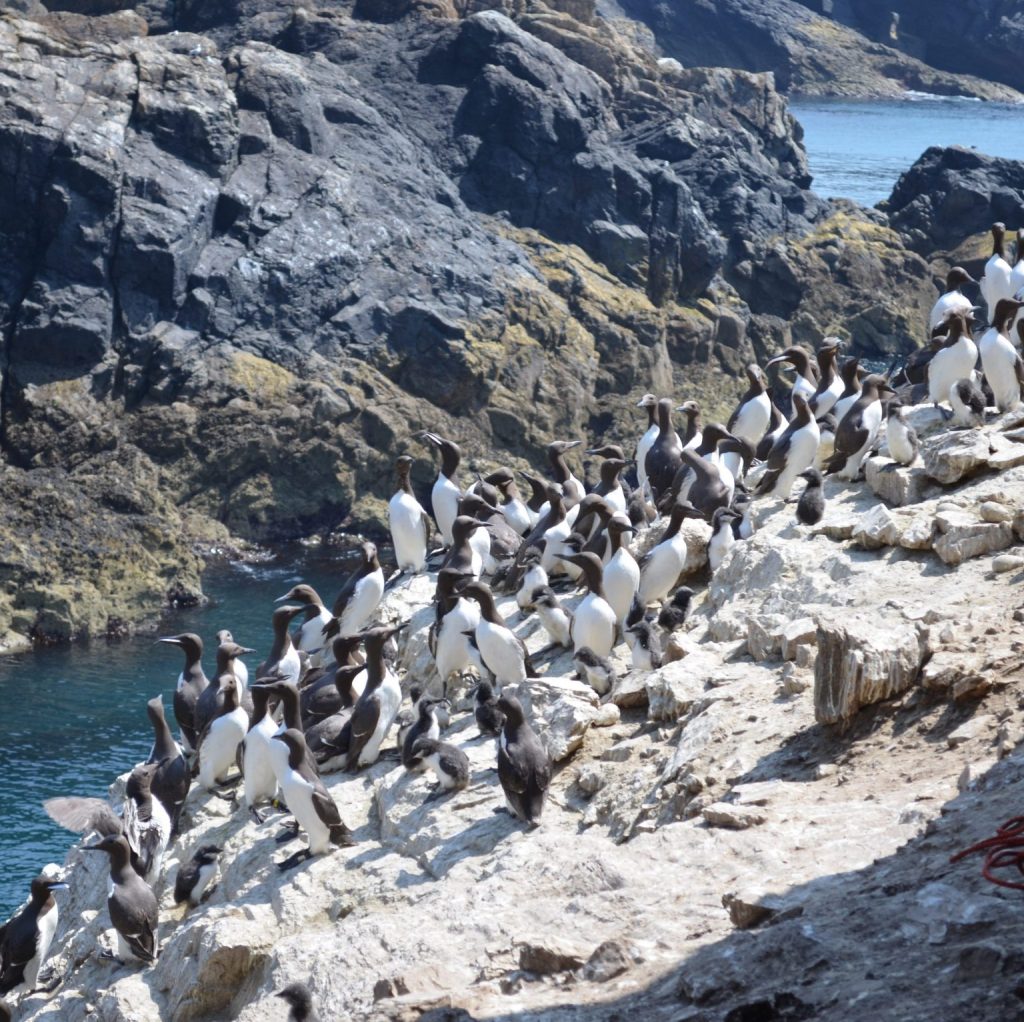
When it comes to raising a family, many animals, including birds, need to carefully pick the perfect spot to lay their eggs. For seabirds like the common guillemot Uria aalge, this choice is especially important because the wrong spot can leave their eggs vulnerable to predators or the elements.
Common guillemots are unique because they don’t build traditional nests. Instead, they choose narrow, sloped cliff ledges to lay their eggs, which means their eggs are at risk of rolling off the edge. But how do these birds keep their eggs safe? It all comes down to the shape of the egg and the features of the cliff ledge itself.

How We Studied the Seabird Nesting Habits
In our study, we wanted to understand how the shape of common guillemot eggs influences their choice of nesting sites on the cliffs of Skomer Island, Wales. The seabirds don’t just pick any spot; they select microhabitats that provide the most stability for their eggs. We expected that birds that lay rounder eggs would prefer surfaces that reduce movement and prevent their eggs from rolling. These surfaces would be those with greater surface complexity, such as depressions, low slopes, and physical barriers like small rocks or walls.
To study this, we took over 2,000 high-resolution photographs of two cliff ledges during the peak of the breeding season. We carefully mapped where the eggs were laid and used large scale markers on the ledges to help us build 3D models later on.


Mapping the Perfect Spot: 3D Models of Cliff Ledges
After collecting the photos, we used photogrammetry software to stitch them together into detailed 3D models of the cliff ledges. These models allowed us to measure various surface features, like the slope (how steep the ledge was), the roughness of the surface (how much friction it offered), and the depth of depressions where eggs might settle.

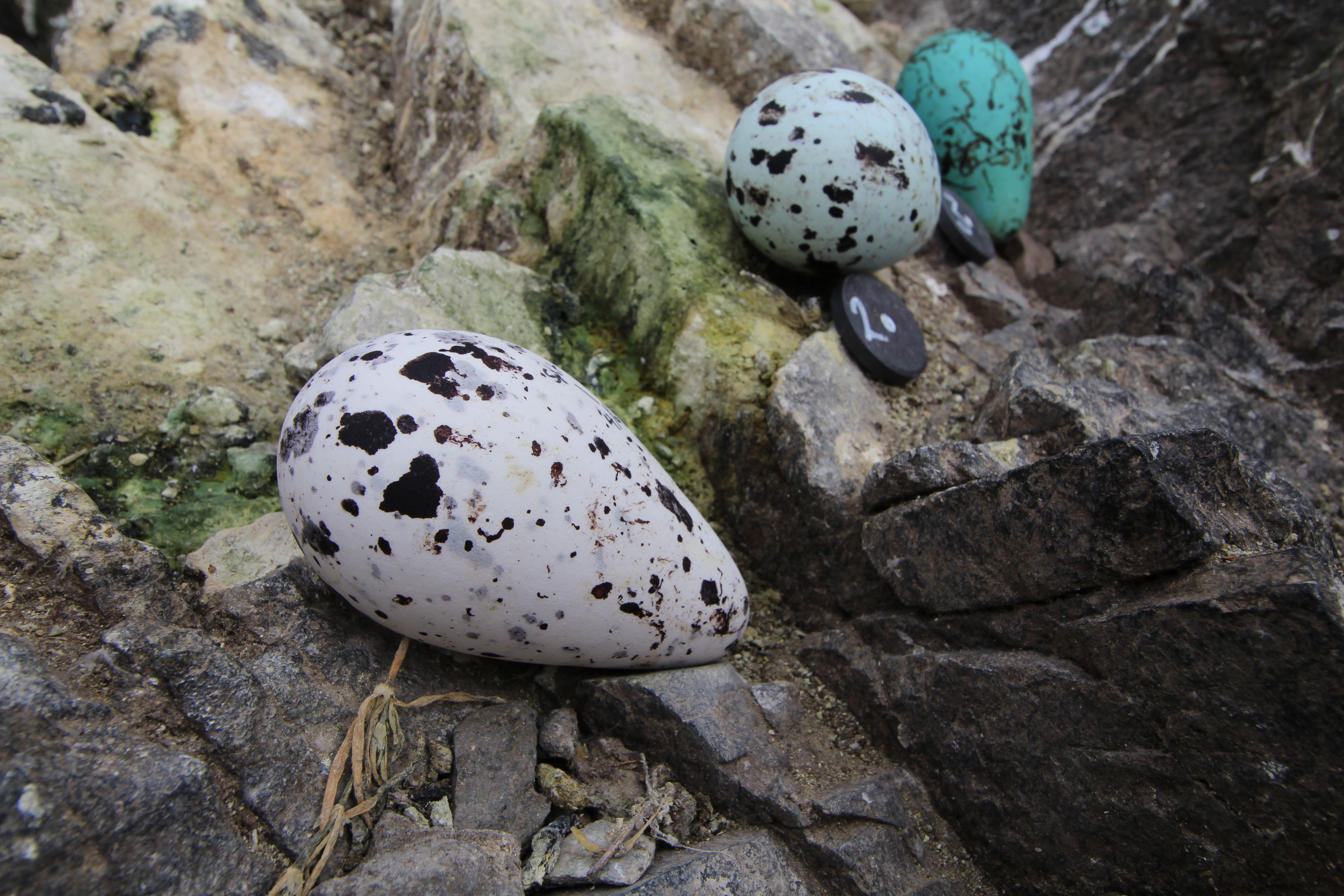
Initial trials using photogrammetry to obtain 3D model of cliff ledge. Each blue square represents the position of the camera when the photo was taken to create a 3D digital surface of a fake green egg and the surrounding ground. Image credit: Marie Attard.
We also created a digital elevation model (DEM) that measured the topography of the ledges with a 10×10 cm resolution, giving us a clear picture of the physical characteristics that influence egg stability. The model helped us quantify important factors like:
- Slope: How steep the surface was and how much risk there was of an egg rolling off.
- Aspect: Which direction the slope faced, affecting how exposed the eggs were to the elements.
- Curvature: Whether the surface was concave (like a bowl) or convex (like a ridge), which determines how sheltered or exposed the egg would be.
- Roughness: How bumpy the surface was, which can slow down the movement of an egg if it starts rolling.
- Relative Depth: How deep depressions in the surface were, which could provide a more stable resting spot for the eggs.
What We Discovered
Our study shows that common guillemots are very selective when choosing where to lay their eggs, relying on the specific features of the cliff ledge to keep their eggs secure. They prefer areas with low slopes, rougher surfaces, and depressions that help hold the eggs in place. This understanding of how seabirds select their nesting sites can give us valuable insight into how they adapt to their environment and ensure the survival of their young.
What’s Next?
Our research is still ongoing, and we’re excited to continue exploring how the shape of the egg and the features of the nesting site come together to influence reproductive success. We’re also working on preparing our findings for publication soon, so stay tuned for more detailed results!
By combining modern technology with an understanding of natural behaviours, we can unlock new insights into the fascinating world of seabird nesting and how these birds have evolved to thrive in challenging cliff-side environments.
 Marie Attard