
Image credit: Pixabay / laurent.breillat
Raising offspring can be a daunting task – one that demands significant time, energy, and resources. But what if you could skip the hard work and leave the burden to someone else? For some species, that’s exactly what they do.
In the animal kingdom, around 1% of all bird species (about 80 in total) have evolved a clever reproductive strategy that saves them the trouble of raising their own young. These birds, known as obligate brood parasites, lay their eggs in the nests of other species, leaving the unsuspecting hosts or “foster parents” to care for the foreign chicks.
This reproductive strategy has evolved independently at least seven times across different bird families, highlighting its clear advantages. While it might be easy for humans (and perhaps even other animals) to spot an egg that doesn’t belong in a nest, the task isn’t always so simple for the host birds.
One of the most remarkable aspects of brood parasitism is the ability of the parasitic bird to mimic the host’s eggs. Brood parasites can match the host’s eggs in size, colour, spots, and even the darkness of the eggshell. This phenomenon, known as egg mimicry, increases the chances of the parasite’s egg being successfully incubated and reared by the host. Essentially, the better the match, the higher the likelihood of the foreign egg surviving unnoticed.
Research Project
While colour and size mimicry in parasitic eggs have been widely studied, egg shape has been largely overlooked. Recent research has hinted that egg shape could also play a role in egg mimicry, with studies such as Underwood and Sealy’s (2006) work suggesting that birds may recognise and eject objects based on their shape. However, until recently, there was no evidence to suggest that brood parasites could mimic the shape of their host’s eggs.
We set out to investigate two main questions:
- Does egg shape and size mimicry occur between brood parasites and their hosts?
- Does the accuracy of egg shape and size mimicry vary with the type of nest?
How Did We Measure Egg Shape?
To investigate these questions, we photographed eggs from parasitised clutches of three generalist cuckoo species to compare differences in egg shape and size between cuckoo-host pairs. Generalist parasites face a unique challenge—they exploit a range of host species, each with potentially different defences against parasitism. The brood parasites we studied included:
- Fan-tailed cuckoo: Parasitises hosts with closed nests.
- Brush cuckoo: Exploits hosts with both open and closed nests.
- Pallid cuckoo: Prefers hosts with open nests.
We took photographs of the entire clutch of eggs and used these images to create egg silhouettes. From these silhouettes, we could generate accurate measurements of each egg’s shape and size.
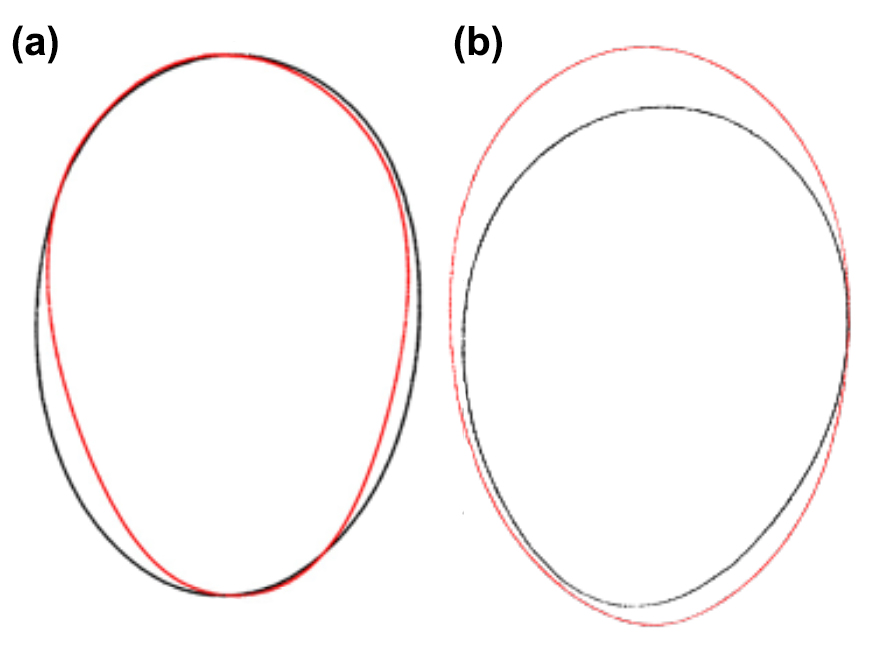
host (black) eggs in our dataset. Figure published in Journal of Evolutionary Biology. 2017. DOI: 10.1111/jeb.13176
Egg Shape Mimicry: A New Discovery
Our research is the first to provide direct evidence of egg shape mimicry between cuckoos and their host species. This supports previous studies that show hosts can recognise and reject foreign eggs based on shape. The host’s ability to detect foreign eggs based on shape may be limited in nests with poor visibility as egg shape mimicry between parasites and hosts only occurred in open nests. We also found that egg size mimicry can occur in cuckoo species that parasitise both open and closed nests, suggesting that hosts may rely on both visual and tactile cues to distinguish between eggs based on size.

Distribution of differences in egg shape (a) between cuckoo–host pairs and (b) between cuckoo and host eggs laid in closed nests and open nests. In panel (a), differences between cuckoo eggs and real host eggs are shown in green and red, and differences between cuckoo eggs and randomly allocated nonhost eggs are shown in blue. In panel (b), points denote average per host species with standard error bars. *** < 0.001. Figure published in Journal of Evolutionary Biology. 2017. DOI: 10.1111/jeb.13176
Conclusion
This study highlights the fascinating ways in which brood parasites have evolved to deceive their hosts. Egg shape mimicry, though previously unexplored, plays a significant role in the survival of parasitic chicks. As we learn more about the intricate dynamics of parasitism, it becomes clear that every detail—from colour to shape—has a purpose in ensuring the parasite’s success.
 Marie Attard