
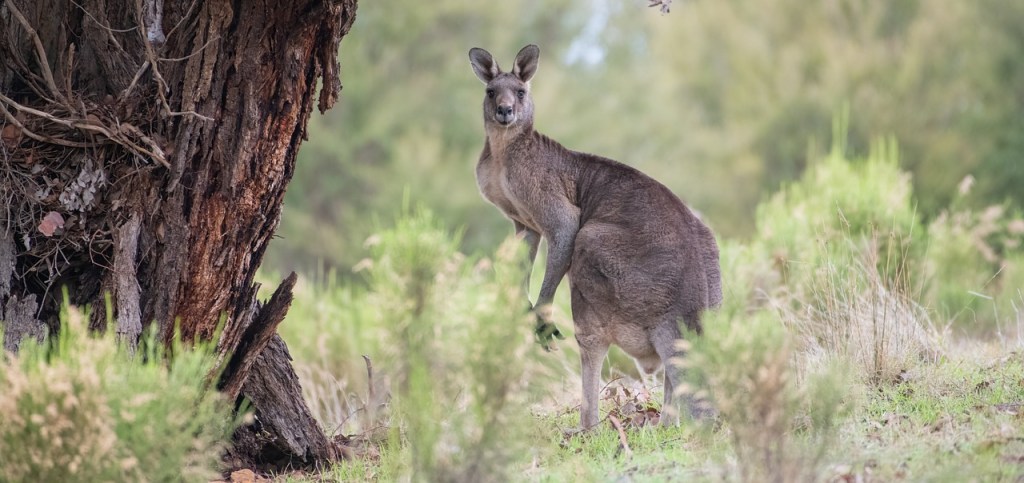
The giant short-faced kangaroo Simosternus occidentalis is one of the largest-known kangaroos that ever existed. It weighed up to 180 kg—roughly the size of a modern grey kangaroo but much bulkier. This species roamed the earth until it went extinct around 50,000 years ago, although some evidence suggests it may have survived until as recently as 18,000 years ago. Many researchers believe that human hunting and climate changes during the Pleistocene era were likely factors in its extinction.
One of the biggest questions surrounding Simosternus occidentalis is whether it could hop like today’s kangaroos. While modern kangaroos are famous for their powerful and efficient hopping, the locomotion of this giant kangaroo has been a subject of debate. Some scientists argue that its size and body structure would have made hopping difficult or even impossible, suggesting that it may have used slower methods of movement. To shed light on this mystery, we used a biomechanical approach to investigate whether this extinct kangaroo species could hop.
How We Studied the Hopping Ability of an Extinct Kangaroo
To understand whether Simosternus occidentalis could hop, we applied a method called finite element analysis (FEA), which helps us model and study the forces acting on an object—in this case, the bones of the kangaroo. Using FEA, we examined how stress would be distributed across the skeleton of Simosternus during hopping. We compared this to thirteen living species of macropods (the kangaroo family), ranging from smaller kangaroos to the larger, modern grey kangaroo.
What We Found
Our results showed clear differences in how stress was distributed across the skeletons of large extant kangaroos and Simosternus occidentalis. For example, larger kangaroos like the grey kangaroo experienced stress differently from the extinct giant. These discrepancies suggest that Simosternus may not have been able to hop in the same way as modern kangaroos. The large size and robust build of Simosternus likely made it more suited to slower, more energy-intensive forms of locomotion.
While the idea of a giant kangaroo hopping like today’s species is fascinating, our findings point to the possibility that Simosternus might have relied on a different, less efficient way of moving—one that may have involved walking or slower bounding.
Looking Ahead
Our study opens the door for more research into the biomechanics of extinct animals. By using modern technology, we can better understand how animals like Simosternus lived and moved in their environments, even if they are long gone. More detailed results from this study will be made available once the research is published, but for now, it appears that hopping was likely not in the cards for this giant kangaroo.
This research not only tells us more about the extinct Simosternus occidentalis, but it also helps us understand how size and body structure can influence the ways animals move, whether they are alive today or have been gone for thousands of years.
Where is it published?
This project was part of John Cook’s PhD thesis at the University of New England, Armidale, and the work is currently being prepared for submission to a peer-reviewed journal.
 Marie Attard